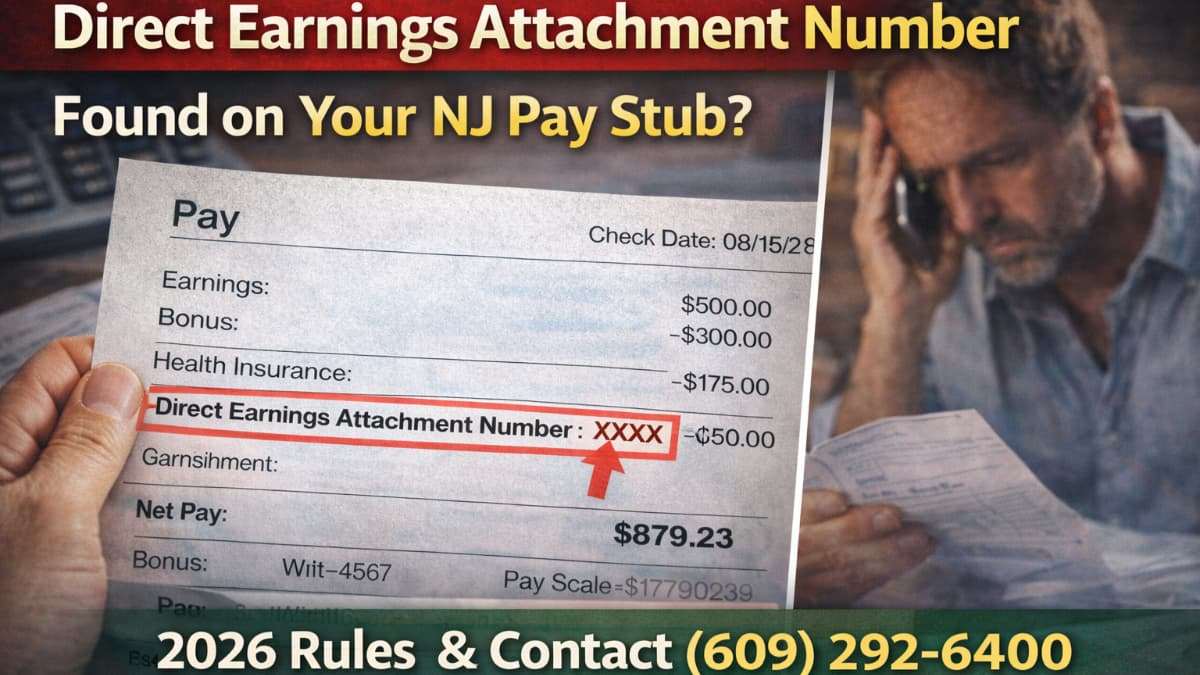
Maria from Trenton lost $400 from her paycheck overnight without warning. If you are experiencing this sudden financial shock, you urgently need your direct earnings attachment number to resolve it. Here is the exact number she called and the steps she took to stop the deduction.
Finding a sudden reduction on your pay stub triggers immediate panic. You must act quickly to protect your income and legal rights. The very first step toward negotiating a release or reducing the deduction is finding the right direct earnings attachment contact number. This comprehensive guide explains New Jersey wage execution limits, the 2026 minimum wage changes, and the exact steps to regain control of your hard-earned money today.
📝 Quick Reference Card: Where to Call
- DEA Phone Number? → Check your pay stub for a code like Writ-XXXX or DEA-XXXX.
- State Tax Debts? → Call the NJ Division of Taxation at (609) 292-6400 or email [email protected].
- Private Debts? → Call your local county Special Civil Part court via njcourts.gov.
What is a Direct Earnings Attachment in New Jersey?
Quick Answer: A direct earnings attachment is a formal legal order requiring an employer to withhold a portion of an employee’s wages to repay a debt. In New Jersey, this is officially called a Wage Execution or Wage Garnishment under N.J.S.A. 2A:17-50. Deductions continue automatically until the debt is satisfied.</p>
⚠️ Note: “Direct Earnings Attachment” (DEA) is sometimes used informally by multinational payroll companies or in the UK, but in New Jersey, it is officially and legally termed a Wage Execution.
2026 NJ Minimum Wage Impact on Garnishments
You must understand the current 2026 legal landscape when dealing with a direct earnings attachment employee notice. Forget vague rumors about “inflation limits”; here are the hard facts for 2026:
- NJ Minimum Wage Increase: As of January 1, 2026, the New Jersey minimum wage increased to $15.92 per hour. This indirectly affects your garnishment floor because federal and state rules protect baseline income tied to the minimum wage.
- Low-Income Protection Rule: New Jersey law provides strong low-income protections. If your disposable weekly income is less than $293.50 (subject to annual 2026 adjustments), standard creditors cannot garnish your wages.
- State Agency Reporting: The NJ Division of Taxation uses automated clearing systems, meaning a direct earnings attachment number is generated and applied to your paycheck much faster than in previous years.
How Much Can Be Garnished? (Federal vs NJ Limits)
New Jersey often provides different, and sometimes stronger, protections than the federal government. A common mistake is confusing federal limits with state limits when a direct earnings attachment number appears on your payroll.
| Category | Federal Limits (CCPA) | New Jersey Limits (N.J.S.A. 2A:17-50 & 56) | What This Means For You |
|---|---|---|---|
| Standard Consumer Debts | Lesser of 25% of disposable earnings OR disposable earnings minus 30× federal minimum wage weekly. | Generally 10% of gross income if income ≤ 250% FPL. Old baseline exempts $48/week. | NJ is often more protective than federal law. The creditor must legally take the lesser calculated amount. |
| Terminology Used | Income Withholding Order (IWO). | Wage Execution or Wage Garnishment. | Your HR department may use these terms interchangeably. |
| Government/State Debts | Standard federal guidelines apply for federal taxes. | Up to 25% possible for state tax debts and judgments. | State and tax debts bypass standard low-income protections. |
| Multiple Orders | Priority goes to child support and federal taxes. | Enforced sequentially (first come, first served) unless it is child support. | You will usually only have one active consumer garnishment at a time. |
Step-by-Step: How to Find Your Wage Execution Contact & Reference
Finding the correct direct earnings attachment phone number is essential to stopping the deduction. Your direct earnings attachment number is not a universal standard code; it is usually a court docket number, writ/execution number, or creditor’s case reference.
- Check Your Pay Stub: Review your earnings statement carefully. Employers list a specific reference code or direct earnings attachment number next to the deduction line.
- Contact Your HR Department: Speak directly with your Human Resources administrator. Ask for a copy of the official wage execution order.
- Identify the Issuing Authority: The order will state who is taking the money (e.g., NJ Division of Taxation, family court, or a private collection agency).
- Call the Direct Earnings Attachment Contact: Use the direct earnings attachment phone number printed on the legal notice. If it is a tax issue, call the NJ Division of Taxation at 609-292-6400.
- Provide Your Reference Number: Immediately provide your specific direct earnings attachment number or court docket number so the agent can locate your file.
How to Object or Stop a NJ Wage Execution
You have legal avenues to challenge the deduction. If the garnishment leaves you unable to afford basic living necessities, you must act fast.
- File an Exemption Claim: When a wage execution is filed, you typically have a strict 10 to 14-day window to file an objection. You can find the official objection form (Obj_wage_garnish.pdf) directly on njcourts.gov.
- Negotiate a Settlement: Call the direct earnings attachment contact number listed on your writ. Creditors often accept a lower lump-sum settlement if paid immediately.
- Request a Payment Plan: For state debts, contact the state to establish an approved installment agreement, which usually suspends the forced garnishment.
- Seek Employer Guidance: For general employer-side wage questions, you can contact the NJ Department of Labor (DOL).
What Happens If I Ignore a Direct Earnings Attachment? (Myth vs Fact)
Analysis of past years shows that employees facing wage executions often panic. Ignoring the direct earnings attachment number notice will only make your situation worse.
- Myth: Quitting your job stops the garnishment forever.
- Fact: The court order remains active. The direct earnings attachment employee order will simply follow you to your next employer once you are hired.
- Myth: My employer can fire me because of this notice.
- Fact: Both federal and state laws prohibit an employer from terminating you simply because your wages are being garnished for a single debt.
- Myth: I can call my bank to block the deduction.
- Fact: The money is deducted by your employer’s payroll department before it ever reaches your bank account.
Frequently Asked Questions (FAQs)
What is a direct earnings attachment in New Jersey? A direct earnings attachment, legally called a Wage Execution in NJ, is a formal mandate requiring an employer to withhold a portion of an employee’s wages to satisfy a legal debt, such as taxes or unpaid judgments.
What is the objection deadline for NJ wage execution? Typically, you have between 10 to 14 days from the date you receive the wage execution notice to file a formal objection with your local county Special Civil Part court to claim an exemption.
How do I find my direct earnings attachment contact number? You can find your direct earnings attachment contact number on the official legal notice sent to your home, or by asking your payroll department. For state taxes, you can call the NJ Division of Taxation at 609-292-6400.
Can I be fired for wage garnishment in NJ? No. Under federal and New Jersey state law, an employer cannot legally fire, discipline, or discriminate against an employee solely because their wages have been garnished for a single debt.
What happens if I have multiple garnishments? In New Jersey, consumer wage executions are generally satisfied sequentially (first come, first served). Only one standard execution is satisfied at a time, though child support and tax debts hold special priority and can bypass this queue.
Connecting Your Tax Workflows
If your wage execution is related to unpaid state taxes, taking proactive steps is the only way to stop the financial drain. We highly recommend reading our guide on How to File NJ Tax Payment Plan Installment Options to see if you can switch to a voluntary monthly payment. Additionally, if your deductions involve variable income, review our Tax On Commission Payments In NJ guide to ensure your employer is calculating your disposable income correctly.
For the most accurate updates, always verify details through official government sources like theNew Jersey Courts website.
Final Verdict
Finding a sudden wage execution on your pay stub is highly stressful, but it is manageable if you act decisively. You must immediately locate your direct earnings attachment number or docket number and contact the issuing agency. By understanding New Jersey’s specific wage limits under N.J.S.A. 2A:17-50 and your right to file an objection via njcourts.gov, you can protect your livelihood. Call the direct earnings attachment contact number on your notice today, or visit njcourts.gov to download the objection form and restore your paycheck.
Sources And Citations
- New Jersey Courts – Wage Execution Forms and Procedures
- New Jersey Division of Taxation – Judgments and Collection
- New Jersey Statutes Annotated (N.J.S.A.) 2A:17-50 & 2A:17-56 (Wage Executions and Exemptions)
- United States Department of Labor – Fact Sheet #30: The Federal Wage Garnishment Law (CCPA)
- U.S. Department of Health & Human Services – Federal Poverty Guidelines
Reviewed by a NJ Licensed Tax Professional.
⚠️ Disclaimer: This information is based on publicly available data, New Jersey statutes, and federal IRS policies as of 2026. Legal thresholds and status updates are subject to official confirmation and change. This is not legal advice. Always verify your information through official government websites ending in .gov or consult a licensed NJ attorney or your county court.
🚨 Stay Updated! Never Miss a Tax Deadline
Rules, deadlines, and refund statuses change constantly in New Jersey. Don't risk missing out on your money. Join our free channels to get instant, real-time alerts delivered straight to your phone.