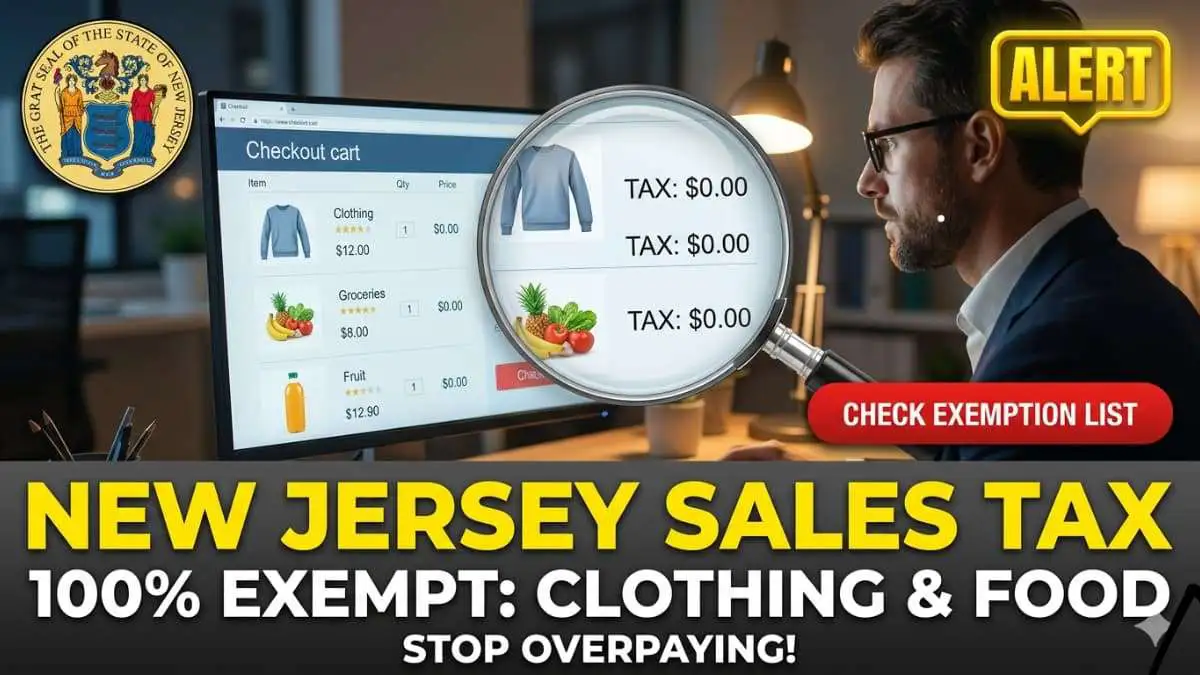
New Jersey Sales Tax 2026: Thousands of residents and business owners lose money daily by overpaying at the register or incorrectly calculating their state liabilities. Understanding exactly which purchases are exempt from state levies can immediately lower checkout totals and help businesses maintain proper compliance.This comprehensive guide breaks down current regulations, local zone exceptions, and the official rules for goods and services. While saving on everyday purchases through sales tax exemptions is helpful, homeowners should also ensure they are claiming their maximumNJ property tax relief 2026 benefits, including the ANCHOR and Stay NJ programs.
🏛 New Jersey Sales Tax Calculator
Official Rates | Instant & Accurate
| 🏪 Standard State Rate | 6.625% |
| 🏭 Urban Enterprise Zone | 3.3125% |
| 👔 Clothing & Footwear | Exempt (0%) |
| 🛒 Unprepared Groceries | Exempt (0%) |
| 💊 Prescription Medicine | Exempt (0%) |
| 💻 Digital Products | 6.625% |
| 🏛 Administered By | NJ Division of Taxation |
Key Takeaways
- Statewide Rate: The new jersey sales tax rate is 6.625 percent across the state.
- Major Exemptions: Most clothing and grocery foods for home consumption are completely exempt.
- Reduced Rates: Certified UEZ sellers may charge 3.3125 percent on qualifying in-person sales.
- Buyer Obligations: A Use Tax of 6.625 percent may apply on untaxed out-of-state purchases delivered into the state.
- Business Compliance: Out-of-state online sellers should strictly verify economic nexus obligations.
April 2026 Legislative Watch: New Jersey legislators have proposed a 5 percent gross receipts assessment on video streaming services in early 2026. Additionally, Newark hotel occupancies now carry a new 3 dollar per day surcharge effective January 1, 2026. This guide reflects the latest confirmed new jersey sales tax rules as of April 11, 2026.
Quick Answer: Current NJ Sales Tax Rate
The current new jersey sales tax rate is 6.625 percent. New Jersey operates as a single-rate state, meaning counties and municipalities do not generally add their own local taxes. However, certified Urban Enterprise Zone (UEZ) businesses and certain Salem County retailers may charge a reduced 3.3125 percent rate on qualifying retail sales.
Does New Jersey Have Sales Tax?
Yes. New Jersey imposes a statewide sales tax of 6.625 percent on most retail sales of tangible personal property, specified digital products, and certain services, unless an explicit exemption applies. When consumers ask if there is sales tax in nj, the standard answer is yes, at a single statewide rate as confirmed by the NJ Division of Taxation Sales Tax Overview.
At a Glance: Taxable vs. Exempt Categories
New Jersey offers numerous exemptions that save residents money. Understanding these categories is essential for accurate budgeting and tax compliance.
| Category | Standard NJ Tax Treatment |
|---|---|
| Statewide Base Rate | 6.625 percent |
| Most Clothing & Footwear | Exempt (0 percent) |
| Grocery Food for Home Use | Exempt (0 percent) |
| UEZ Certified Businesses | 3.3125 percent (On qualifying sales only) |
| Untaxed Out-of-State Purchases | 6.625 percent Use Tax may apply |
Specific Exemptions: Clothing, Food, Furniture, Services
Is Clothing Taxable in New Jersey?
Most clothing and footwear intended for human use are completely exempt from new jersey sales tax. Some items remain taxable, such as fur clothing, specific accessories, and certain specialized sport or recreation equipment. When searching for new jersey sales tax clothing online, the rules remain identical. Exempt clothing generally remains exempt regardless of whether it is purchased in-store or through a mail-order channel.
Practitioner Note: A common new jersey sales tax audit trigger is the misclassification of clothing accessories, such as jewelry and sports cleats, as standard exempt apparel. Always document the exemption rationale and utilize official NJ tax exemption certificates.
Is Food Taxable in New Jersey?
Most food sold for off-premises home consumption (groceries) is exempt from state tax. However, certain prepared foods, heated meals, and beverages are taxable. Restaurant meals are generally taxable at the standard 6.625 percent rate.
Is Furniture Taxable in New Jersey?
Furniture is generally taxable at 6.625 percent because the state classifies it as tangible personal property. Furthermore, delivery charges for taxable items are generally taxable in New Jersey. If a buyer purchases taxable furniture delivered into New Jersey and the out-of-state seller does not collect the tax, the buyer may owe Use Tax based on the NJ Treasury Out-of-State Sales Guidelines.
Is Jewelry Taxable in New Jersey?
Jewelry is generally taxable at 6.625 percent. Because it is legally treated as a taxable clothing accessory and tangible personal property, standard state tax applies to rings, necklaces, watches, and similar items.
What Services Are Taxable in New Jersey?
New Jersey taxes certain services, but not all of them. For example, maintaining, servicing, or repairing real property is generally taxable unless the work results in an exempt capital improvement. Many professional services are exempt, but services like landscaping, physical security, and telecommunications carry the standard 6.625 percent tax.
Are Digital Products Taxable?
Specified digital products, including digital audio-visual works, digital audio works, and digital books, are generally taxable at 6.625 percent when permanently downloaded or transferred electronically to a user in the state. However, digital products that are merely accessed or streamed but not delivered to the purchaser’s device, such as a movie watched on a streaming service, are generally exempt from new jersey sales tax. Always verify the specific product category under current guidance via the NJ Division of Taxation Digital Products Bulletin.
2026 Legislative Update: As of early 2026, New Jersey legislators have proposed a 5 percent gross receipts assessment specifically on video streaming services. This proposal is separate from the existing new jersey sales tax framework and has not yet been enacted into law.
Repeal of the NJ Sales Tax Holiday
New Jersey previously observed an annual sales tax holiday period covering school supplies, art supplies, instructional materials, and computers. However, state legislation has officially repealed this program. The sales tax holiday will no longer occur in 2026 or any future years. Standard new jersey sales tax applies to all school and art supplies unless they are specifically exempt under another general rule (such as everyday clothing).
NJ Sales Tax by City and County
Because New Jersey uses one statewide rate, cities and counties do not normally impose their own standard local sales tax. Differences in practical tax rates only occur if a purchase qualifies for a special reduced-rate program.
| Location | Normal Rule | Reduced-Rate Possibility |
|---|---|---|
| Bergen County | 6.625 percent statewide rate | No normal county add-on |
| Cherry Hill | 6.625 percent statewide rate | No normal city add-on |
| Jersey City | 6.625 percent standard rule | 3.3125 percent only at qualifying certified UEZ sellers |
| Newark | 6.625 percent standard rule | 3.3125 percent only at qualifying certified UEZ sellers |
Millville Special District Warning: Millville, located in Cumberland County, imposes an additional 2 percent special local tax within the Millville Sports and Entertainment District on specific purchases including food, drink, entry fees, and hotel stays. This is charged on top of the standard new jersey sales tax rate of 6.625 percent.
Newark 2026 Update Warning: Beginning January 1, 2026, hotel occupancies in Newark are subject to an additional 3 dollar per day surcharge. This is imposed on top of the standard hotel taxes, but the state has clarified that the 3 dollar surcharge itself is not subject to the new jersey sales tax. Furthermore, local municipal budgets often drive up the overall tax burden. If local assessments feel too high, taking action beyond finding sales tax discounts is possible by learninghow to appeal your property tax assessment.
How NJ Sales Tax Compares to Neighboring States
Understanding the new jersey sales tax rate in regional context helps explain why programs like the UEZ half-rate were specifically created.
| State | Statewide Sales Tax Rate | Notable Difference vs. NJ |
|---|---|---|
| New Jersey | 6.625 percent | Single statewide rate; no local add-ons (except special districts) |
| New York | 4.000 percent state plus local | NY effective rate is often 8 percent or higher with local additions |
| Pennsylvania | 6.000 percent | Philadelphia adds a 2 percent local tax |
| Delaware | 0.000 percent (No sales tax) | Primary reason NJ created the UEZ half-rate program |
| Connecticut | 6.350 percent | Some luxury goods are taxed higher |
Delaware’s complete absence of a state sales tax is the primary competitive pressure that led New Jersey to create the UEZ reduced new jersey sales tax rate of 3.3125 percent for border-area businesses.
Urban Enterprise Zones (UEZ) Explained
A certified UEZ business may charge half of the normal state rate, currently 3.3125 percent, on qualifying retail sales of tangible personal property.
A city being designated as a UEZ does not mean every purchase automatically gets the half-rate. The reduced rate is available only through certified UEZ sellers on eligible transactions. For an in-person purchase, the transaction must physically occur at the vendor’s place of business within the zone, and the buyer must accept delivery there or have it delivered directly from that same UEZ location. Review the NJ Division of Taxation UEZ Requirements for exact delivery criteria.
Additionally, full-rate tax still applies to specific categories, including motor vehicles, alcoholic beverages, cigarettes, energy, and charges for services.
Business Compliance Note: Annual limitations apply to purchases eligible for new jersey sales tax exemption for businesses using UZ-5 and UZ-4 certificates (currently capped at 100,000 dollars). Certain supermarkets in food desert communities may qualify for exceptions.
Salem County Reduced Rate Rules
Certain sales by authorized businesses located in Salem County are taxable at the reduced 3.3125 percent rate. This reduced rate generally applies to qualifying retail sales of tangible personal property, but it is not a blanket rate for all transactions.
According to the official ST-450 guidelines, the state specifically excludes several categories from the Salem County reduced rate benefit:
- Prepared food and restaurant meals
- Motor vehicles
- Specified digital products
- Alcoholic beverages and cigarettes
- Services (including repair and maintenance)
- Room occupancy and hotel stays
- Admissions and amusements
- Parking, garaging, or storing a motor vehicle
- Membership fees for health, sporting, or shopping clubs
- Sales made from locations outside Salem County (including catalog and mail-order)
Understanding NJ Use Tax
Use Tax applies when a taxable item or service is bought outside New Jersey, delivered into New Jersey, and the buyer either paid no tax or paid tax at a lower rate than New Jersey’s standard rate. The general New Jersey Use Tax rate is 6.625 percent, directly matching the sales tax rate. Buyers may owe Use Tax on untaxed online purchases. If a mistake was made on a past return regarding Use Tax reporting, taking proactive steps is critical. Learn the proper procedure in the guide onNJ tax filing errors refund processing 2026 to properly report and remit these amounts on the resident income tax return.
Calculation Examples for Consumers
Use this simple formula for standard taxable purchases: Purchase price times 0.06625 equals NJ Sales Tax
- Furniture purchase: 800 dollars times 0.06625 equals 53.00 dollars tax
- Jewelry purchase: 2,000 dollars times 0.06625 equals 132.50 dollars tax
- Most exempt clothing: 150 dollars times 0 equals 0 dollars tax
For real-time new jersey sales tax calculations on any purchase amount, refer to the official resources at the New Jersey Division of Taxation.
Filing and Payment Basics for Businesses
Out-of-state sellers may be required to collect and remit new jersey sales tax if they exceed economic nexus thresholds. Always verify current NJ nexus rules directly at the NJ Division of Taxation before assuming no obligation exists.
Businesses that collect New Jersey Sales Tax must register and file as required by the state. Business owners must also track the NJ tax deadline 2026 to avoid missing the filing cutoff for resident income tax returns and business filings. Follow these critical steps to remain compliant:
- Register your business with the state at least 15 business days before collecting new jersey sales tax.
- Collect the correct rate on qualifying sales.
- Keep clear records that strictly separate exempt items from taxable items.
- File your sales and use tax returns electronically through the official New Jersey tax system.
- Remit the collected funds strictly according to the state-assigned filing schedule to avoid penalties.
Common Mistakes New Jersey Taxpayers Make
Based on state tax guidelines, taxpayers frequently face compliance audits due to these specific misunderstandings:
- Assuming entire UEZ cities have lower taxes: Only certified businesses within a UEZ can charge the 3.3125 percent rate. A non-certified store in a UEZ city must charge the full 6.625 percent.
- Ignoring economic nexus thresholds: Not verifying economic nexus before assuming no new jersey sales tax obligation applies to remote online sales into the state.
- Applying the UEZ rate to remote sales: Applying the UEZ reduced rate on mail-order or telephone sales is incorrect; these must be taxed at the full new jersey sales tax rate of 6.625 percent.
- Ignoring Use Tax obligations: Buyers often overlook that they may owe Use Tax on untaxed out-of-state purchases delivered into New Jersey.
- Confusing capital improvements with repairs: Contractors sometimes mistakenly charge tax on capital improvements instead of securing a Certificate of Exempt Capital Improvement (Form ST-8) from the property owner.
For related compliance issues regarding missed payments, review our guide on the NJ tax underpayment penalty 2026 regulations.
Frequently Asked Questions
Does New Jersey have sales tax? Yes. New Jersey generally imposes a 6.625 percent statewide sales tax on many taxable goods, specified digital products, and certain services unless a specific exemption applies.
Is clothing taxable in New Jersey? Most clothing and footwear intended for human use are completely exempt from New Jersey sales tax. Some exceptions apply for items like fur clothing and specific athletic equipment.
Why do some Newark or Jersey City stores charge less sales tax? Some certified UEZ businesses may charge a reduced rate of 3.3125 percent on qualifying in-person purchases. However, the entire city does not automatically get that reduced rate.
What is the NJ Use Tax rate? The New Jersey Use Tax rate is generally 6.625 percent, which matches the standard state sales tax rate. It applies to untaxed taxable goods delivered into the state.
Is there new jersey sales tax on cars? Yes. The sale of a motor vehicle is generally subject to the 6.625 percent new jersey sales tax.
Does new jersey sales tax apply to shipping charges? Yes. In New Jersey, delivery and shipping charges for taxable items are generally taxable. If the item being shipped is tax-exempt, the delivery charge is also exempt.
Is new jersey sales tax charged on SaaS or software subscriptions? Pre-written computer software delivered electronically is generally subject to the state sales tax. However, cloud-based Software-as-a-Service (SaaS) accessed remotely and not delivered electronically is generally exempt.
Is there new jersey sales tax on gasoline? Motor fuels like gasoline are generally exempt from standard sales tax at the pump because they are subject to separate state motor fuel excise taxes.
What happens if I don’t collect new jersey sales tax as a business? Failing to collect and remit the required tax can result in severe state audits, financial liabilities for the uncollected tax, and additional underpayment penalties.
Can I use the Salem County reduced rate for online sales? No. The Salem County 3.3125 percent reduced rate applies to qualifying in-person retail sales and explicitly excludes mail-order, catalog, and internet sales.
For the most accurate updates, always verify details through official government sources.
Final Verdict
Navigating the new jersey sales tax requires understanding that while the base rate is strictly 6.625 percent, significant exemptions exist for everyday necessities like standard clothing and groceries. Businesses, especially out-of-state online sellers, must verify economic nexus thresholds before assuming no new jersey sales tax obligation exists. By identifying certified Urban Enterprise Zone businesses, understanding digital product taxability nuances, and maintaining proper exemption documentation, both consumers and businesses can achieve full compliance and minimize audit risk.
Official Resources
For official documentation and filing portals, refer directly to the New Jersey Division of Taxation:
- New Jersey Sales Tax Guide (S&U-4)
- Urban Enterprise Zone (UEZ) Overview
- Making Mail-Order and Internet Sales (S&U-5)
- Out-of-State Sales & New Jersey Sales Tax (ANJ-10)
- Sales Tax Exemption Administration (S&U-6)
Disclaimer
This guide is for general informational purposes only and is not legal or tax advice. For transaction-specific or business-specific guidance, always check the New Jersey Division of Taxation or speak directly with a qualified tax professional.
Author Information Written by: Marcus Throne, CPA Marcus Throne is a New Jersey licensed Certified Public Accountant specializing in state tax compliance, retail tax regulations, and federal relief programs. Verify his active license status at the New Jersey State Board of Accountancy official portal. Reviewed by: Sarah Jenkins, EA Sarah Jenkins is an Enrolled Agent (credentialed by the IRS — verify EA credentials at the IRS RPO database) specializing in state tax liabilities, business compliance, and individual tax planning strategies.
Last Updated: April 11, 2026 Written by: Marcus Throne, CPA Reviewed by: Sarah Jenkins, EA Fact-Check Policy: This guide was reviewed against official New Jersey Division of Taxation publications, Urban Enterprise Zone program guidelines, and state tax bulletins as of April 2026.
🚨 Stay Updated! Never Miss a Tax Deadline
Rules, deadlines, and refund statuses change constantly in New Jersey. Don't risk missing out on your money. Join our free channels to get instant, real-time alerts delivered straight to your phone.
